Turkey Teeth: What the Trend Really Means
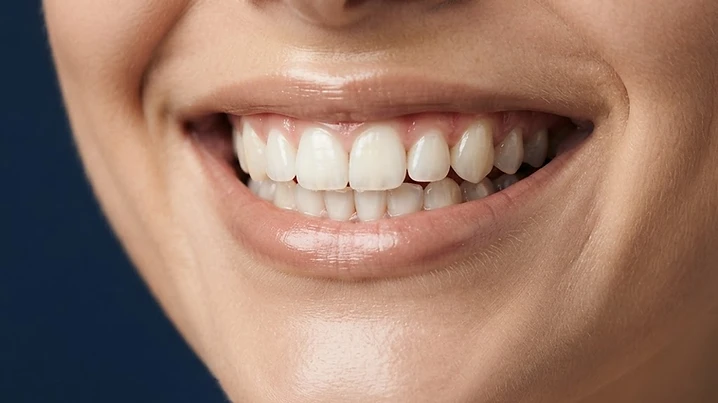
“Turkey teeth” is a phrase from British social media rather than from dentistry. It usually describes a full set of bright, uniform crowns fitted in a single week abroad — the look made famous by reality television. Some of those cases are careful, well-planned treatment. Others are the opposite, and the difference is not visible in a before-and-after photograph.
This page explains what is actually involved, why outcomes vary so widely, and how to tell which kind of clinic you are dealing with. None of it is an argument against treatment in Turkey — it is an argument for understanding what you are buying.
What the treatment usually is
In most “Turkey teeth” cases, the treatment is a full set of crowns: twenty or more units covering the visible teeth, fitted over several days. Sometimes veneers are used, and sometimes the work is a mix of crowns on back teeth and veneers at the front.
Where the criticism comes from is preparation. Covering a tooth in a crown means removing some of its outer layer. If a healthy tooth is heavily reduced to make room for a crown, that tooth now depends on the crown for the rest of its life — and every future replacement removes a little more. Dentists who disagree with the trend are usually disagreeing with that, not with travel.
Why results vary so much
Three variables decide whether a set of crowns looks convincing and lasts: how the teeth were prepared, what material was used, and how carefully the bite was checked. A clinic that takes a scan, plans the tooth positions, uses a good laboratory and gives itself enough days will produce a different result from one working to a fixed five-day turnaround with no planning stage.
The second variable is you. Crowns cannot be undone, and they need care: cleaning between them, protecting them from heavy grinding, and returning for a review. Patients who treat the work as finished on the flight home tend to be the ones who need problems resolved later.
Not sure which treatment applies to you? A coordinator will go through it with you.
Questions that separate the careful clinics from the rest
Ask these before you pay a deposit. The answers tell you far more than a gallery of photographs.
- How much tooth will be removed, and could a more conservative option — veneers, bonding, orthodontics — do the job?
- What material are the crowns, and which laboratory makes them?
- Who examines me and who decides the plan?
- What is the fee if a crown needs replacing, and what is the process if something is wrong when I get home?
- How many days are allowed, and what happens if the laboratory needs longer?
Where SmileOver stands on it
We fit a lot of zirconia crowns, and we will not pretend that a full set is never the right answer — for teeth that are worn, heavily filled, broken down or discoloured beyond what whitening and bonding can help, crowns can be the honest choice. What we will not do is sell a set of crowns to someone whose teeth do not need them.
If less invasive treatment would give you a better long-term result, we will recommend that instead, even where it earns us less. That conversation begins with photographs and an assessment: request a free one, or read about zirconia crowns in Turkey for the detail.
Turkey Teeth: What the Trend Really Means: questions patients ask
Are Turkey teeth safe?
The treatment itself is standard dentistry and is carried out safely in well-run clinics every day. The risks come from excessive preparation of healthy teeth, rushed planning and no aftercare route. Ask what will be removed before you agree to anything.
Do I have to have all my teeth crowned?
No, and often you should not. Where a few teeth need crowns, treating a few teeth is better. Full sets are for cases where most of the visible teeth genuinely need covering.
How long do the crowns last?
Zirconia crowns are durable and many patients keep them for well over a decade, but lifespan depends on your bite, your habits, your cleaning and whether you grind your teeth. No clinic can honestly promise a fixed number of years.
Can I choose a natural shade rather than a very white one?
Yes, and we would encourage it. The shade is planned with you before the crowns are made; a shade that suits your face and skin tone usually looks better than the brightest available.
Will I need my teeth filed down?
Some preparation is needed for any crown. The question is how much, and whether a more conservative option would work. Your dentist should explain and show you the plan before treatment starts.
Can crowns be replaced with something else later?
They can be replaced with new crowns, but the tooth underneath has already been reduced. That is why the first decision matters so much.
Thinking about dental treatment in Turkey?
Speak to the SmileOver team about your individual requirements. We will tell you which treatments are likely to suit you, what a realistic timeline looks like, and what the cost would be — in writing, before you commit to anything.
No guarantees are made about results, and no medical advice is given before an assessment. Everything on this page is general information for UK patients.
How to read this page
SmileOver is a coordination service. We arrange consultations, written treatment plans, airport and clinic transfers, accommodation and aftercare contact for patients travelling from the UK and elsewhere.
Clinical care — diagnosis, treatment planning and the treatment itself — is provided by the independent dental clinic and its registered dentists in Turkey. SmileOver does not practise dentistry and does not decide which treatment you need.
Every page here is general information, not medical advice. Your dentist will assess your own teeth, and treatment varies between patients. No outcome is guaranteed and no treatment is suitable for everyone.
Related reading for UK patients
More detail on the questions that come up most often, and the pages that explain how treatment with SmileOver is organised.